
2025 – Comparison Guide Between LLM vs Generative AI

Introduction
In this guide, you will get the most comprehensive details, which include highlighting the comparison between LLM and generative AI. These two technologies are the most transformative AI technologies, majorly used in all small and big projects.
The prime focus of the blog is to cover the key differences between generative AI and LLM, with real-time cases and when to choose it, and the benefits that it brings to the businesses. Let’s dive into it.
The landscape of artificial intelligence is evolving rapidly and 2025 marks one of the decisive years where two major transformative technologies (Large Language Models (LLMs) and Generative AI) stand at the forefront of innovation.
The terms often used are interchangeable, but they represent distinct paradigms focusing on a broader AI ecosystem. The industries across the globe are accelerating their digital transformation along with understanding the functional differences, and thus,, with real-time use cases of LLMs vs. GenAI, it is no longer considered as an option; rather, it’s essential.
The guide offers a clear, tech-oriented breakdown of how these technologies are different from each other, where they converge, and how they are reshaping the entire experience from content creation to developing a code and from custom software development to enterprise automation.
Whether you are a developer, AI enthusiast, or business leader, this comparison guide is a complete demystification of the buzzwords and provides practical insights into the architecture, applications, and future trajectory of LLMs and Generative AI in 2025.
Comparison Table: Generative AI Vs LLM
Before moving further with a detailed comparison between the two, here is a high-level overview first. The below-mentioned comparison between generative AI and LLM will clear your doubts and deliver a proper understanding between the two.
Defining Generative AI
Generative AI basically refers to a class of artificial intelligence systems that is designed to create new and engaging content. It includes anything from images, text, and music to videos and even code.
The overall thought process behind generative AI is to learn from extensive data and later create new, original content that represents and depicts the pattern and characteristics of the content that is being learned.
There are several types of generative AI models, but one of the most popular is based on deep learning. The particular data that is used in GANs and transformers are GPT-3 and GPT-4.
Applications of Generative AI:
- Text generation (like writing stories, articles, or code).
- Image generation (e.g., creating realistic artwork, deepfakes, or synthetic photos).
- Music composition (creating original music based on existing patterns).
- Video generation (creating animations or even synthesizing real-world scenes).
- Data augmentation (developing and creating factual data to ensure improvisation in ML models).
Live Examples of Generative AI
“Generative AI isn’t just about mimicking reality; it’s about crafting new worlds from the data of our dreams.”
– Anonymous
Let us share some of the key examples that are helping businesses and enterprises globally with their creativity and innovation through GenAI.
- DALL-E: A tool designed by OpenAI, is best for generating text-to-image content in high-quality, unique, and aesthetic form from simple text descriptions in the input prompts. Also, it is an ideal tool to help design marketing visuals and prototypes in creative forms that bring ideas to life.
- Midjourney: For the designers and artists who, through their art, present their thoughts, Midjourney is the best GenAI platform. The technique used is deep learning, which helps co-create aesthetic visuals, directing a high level of output from the users.
- Runway ML: It is the platform designed for creators who always want something unique in their video. Thus, the tool is best suited for generating and editing video content through text-based instructions. Runway is the best tool that helps put high-end video production into the best art form by removing backgrounds and by creating and generating AI avatars in cinematic effects.
- GitHub Copilot: The best app for the developers whose whole world revolves around writing, optimizing, and debugging the code. Developed by GitHub and powered by OpenAI’s Codex, Copilot is the real-time coding assistant for the developers. The GenAI platform helps suggest the code to the users, as it understands the process of natural language. With less error and speedier development, the app is ideal for all the programmers.
- DreamStudio: Powered by Stability AI, the functionality and design of DreamStudio is to generate instant visuals with the help of Stable Diffusion models. It is the most popular and used platform for digital creators who look for instant and stylized graphics that look aesthetic.
Used Cases of Generative AI
Let us understand some of the use cases where GenAI has proven to be the best option and delivered fruitful results and outcomes.
- Marketing and Content Creation: Whether you need to write blog posts, design social media posts, or create videos, the tool GenAI is the best. It creates the work that helps boost your efforts and connect with the right audience by boosting it.
- Product Design and Prototyping: Tools like Figma AI help generate multiple product designs in one single go and variations based on users' inputs. It helps reduce manual efforts and errors while increasing the speed of the design process.
- Predictive Analytics and Forecasting: Unlike LLMs, generative AI is a trained model that helps simulate outcomes, forecast trends, and predict future scenarios. Having the capability of predictive analysis, the GenAI platform is extensively used in finance, supply chain, and climate modeling.
- Customer Engagement: Let the real-time customer queries in the businesses be handled by AI-driven chatbots having GenAI models. It can also help form personalized replies for different users and reduce support costs significantly.
- Synthetic Voice and Music Composition: For the users who work on creating ads, podcasts, and videos for their audiences, this cutting-edge technology is the best. The GenAI tool here is used in multiple ways, like voice cloning, music scoring, and creating soundtracks based on emotions.
- 3D Modeling and Environment Creation: Industries like gaming, virtual productions, and fashion, where there is a need to design 3D avatars and model designs for them GenAI is the biggest blessing. It not only creates personalized designs and models but also generates attention-grasping storylines with interactive voices and dialogues, helping create an immersive experience.
Introducing Large Language Model
Large language models are deep learning models specifically trained on massive amounts of text data from books, websites, articles, and more. The ultimate ideation is to understand the pattern of the language with proper understanding. It can be in the form of how words, sentences, and concepts relate to each other, helping generate or predict text that makes sense to the complete data.
Applications of Large Language Model:
- Chatbots and virtual assistants (like me!)
- Automated content creation (articles, emails, stories)
- Language translation
- Text summarization
- Sentiment analysis
- Coding assistance
Examples of Large Language Model
“Large Language Models don’t just process words; they understand the heartbeat of human thought.”
– Anonymous
- OpenAI’s GPT-4: The best LLM used mode of OpenAI’s series is GPT. GPT-4o is probably the most renowned and recommended LLM in the world currently, post the success of GPT-3. It is wrong to say that the transformation of diverse industries is now possible with the help of GPT applications.
- Anthropic’s Claude: Claude is a conversation LLM designed and developed keeping safety and precaution in mind. It further ensures prioritizing using it ethically and with proper alignment. With the rise in its popularity, it has been a reliable alternative among the biggest rivals to OpenAI’s models.
- Google’s PaLM 2 and Gemini: These LLM models are Google power tools like Bard and Google Workspace. The specialty of this is that it excels in multi-language understanding and delivers product-oriented data like email drafting or summarizing documents.
- Meta’s LLaMA (Large Language Model Meta AI): Another best example of LLM is LLaMA. It is one of the most reliable and open-source models that the researchers and developers use to enhance their programming speed, code generation, and much more. Further, it can also be trained under various use cases, including domain-specific applications.
Large Language Model Use Cases
“Large Language Models are transforming the way we work, learn, and create. From crafting compelling content to providing real-time customer support, their versatility is unlocking new possibilities across every industry.”
Whether it is a startup or a fully established enterprise, LLM is right there solving real-time challenges that demand understanding and generating human-mimic languages. Let’s see the best real-time use cases of LLM.
- Customer Support Automation: One of the best applications of LLMs is the art of automating customer support. Having LLM-based chatbots, the queries are handled with the ease and the availability is 24/7 with instant resolutions.
- Content Generation and Summarization: Whether you need to create/develop content like blogs, articles, posts, or social media content, LLM is the best choice as it summarizes the content without any changes in the meaning of the actual content.
- Coding Assistance: Large language models, such as GitHub Copilot, help developers and programmers to generate, create, develop, and debug the code script hassle-free. These models are great for code suggestions, error fixing, documentation, and even generating snippets in multiple languages.
- Search and Knowledge Management: As an expert partner, LLM helps replace keyword-based searches with semantic, context-aware queries. It also helps understand and retrieve the data from the massive internal data into a smart knowledge base.
Let our LLM development services help you, handle your customer query and excel responding by generating human-like text.
Statistical Data
Industries Using the LLM Vs GenAI
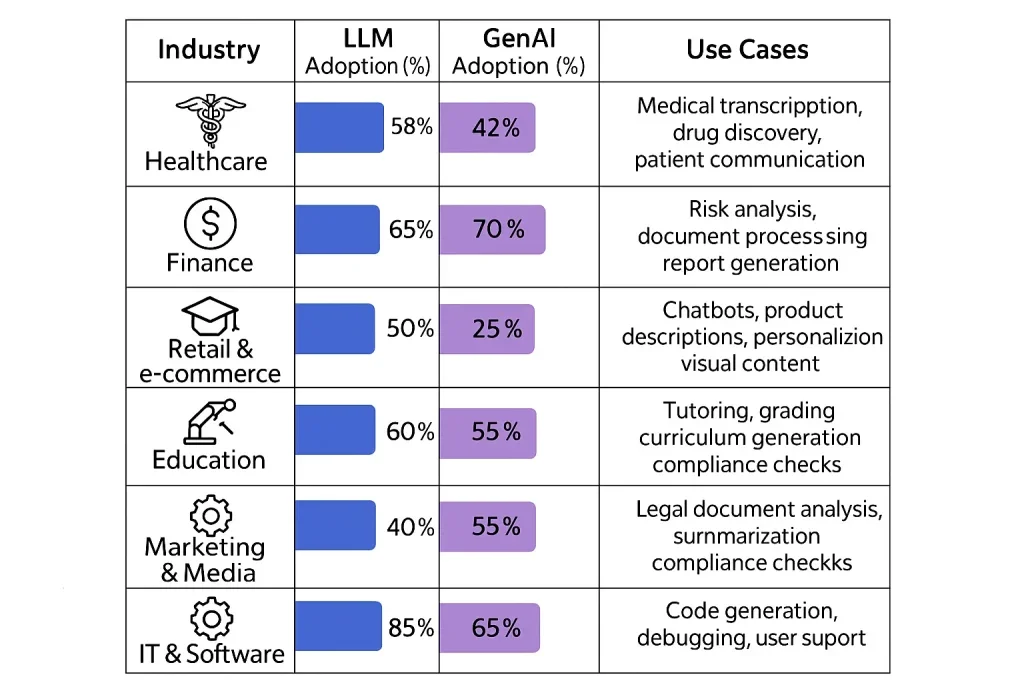
Comparison between LLM and Generative AI
Large Language Models (LLMs) and generative AI seem to be each other’s companions. Although it has similarities, they differ in various parameters.
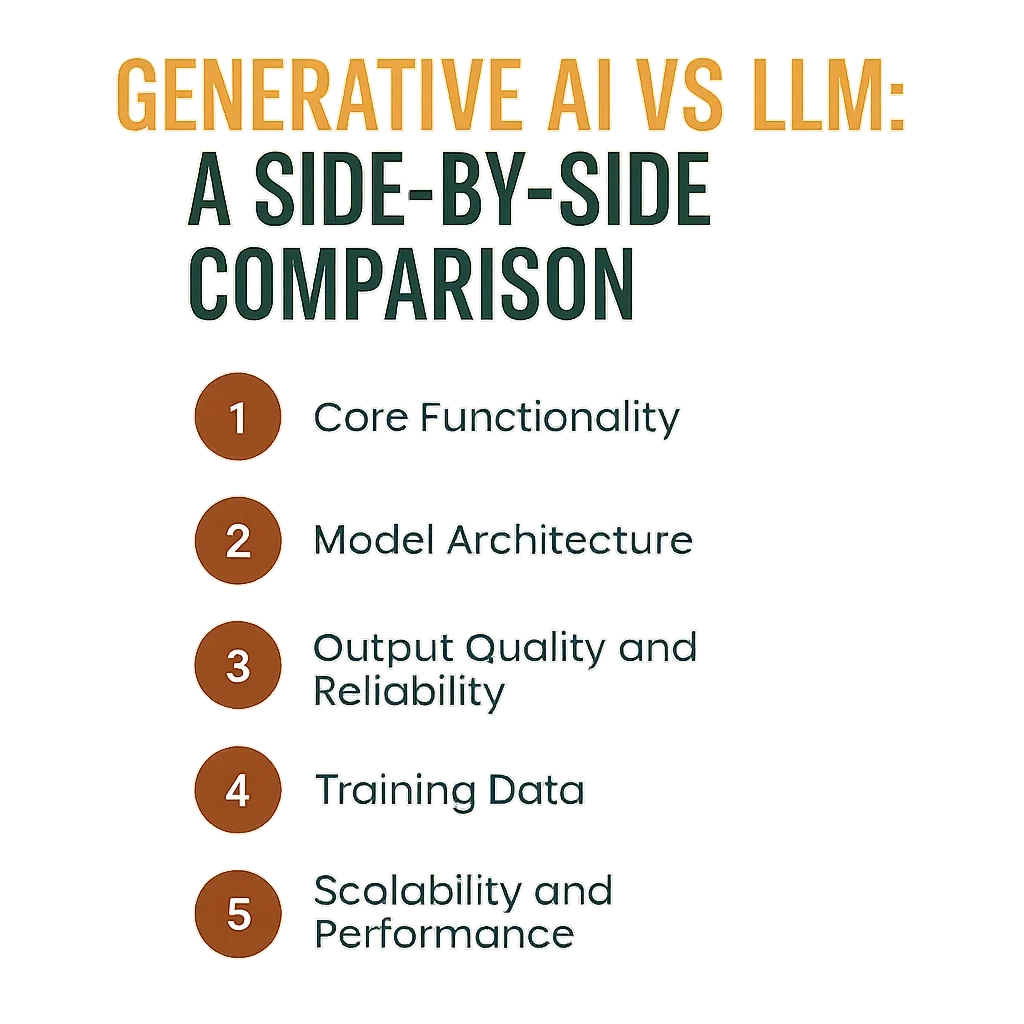
To understand what makes GenAI and LLM different from each other and how you can select the right approach, here is an in-depth comparison for both.
Well, it would not be wrong to say that LLMs are indeed a powerful subset of generative AI. The only reason to do it is because it focuses on understanding the languages. LLMs undoubtedly have great potential to transform the generated data and interact with textual data.
While for creating content generation, GenAI has broader experience with a range of capabilities to cross all the boundaries to deliver the best content.
We at iQud hope that our guide discussing LLM vs. generative AI helps you understand the core difference between these two high-in-demand technologies. Knowing when to use the respective technologies helps the businesses to plan strategically and invest in the best AI-powered solutions that align with their unique business goals and needs.
Frequently Asked Questions
Is there any difference between LLM and GenAI?
The capability of generating convincing data is possible with the help of LLM because it requires accuracy and precision. Whereas GenAI models handle these types of data in a much better way by their own challenges. Ex: image quality or coherence.
With LLMs and GenAI technologies, which industries benefit?
LLMs have extensive capabilities in understanding the languages. Thus, it is more used in enterprises for customer service automation, document analysis, finance reporting, and HR management. On the contrary, GenAI is mostly used in marketing product design, and companies focus on creating creative content.
| Comparison Parameters | Generative AI | Large Language Model |
|---|---|---|
|
Definition |
A broad category of AI helps generate different types of content: images, text, videos, music, and code. |
It is a subset of generative AI that is specifically designed to understand and generate human-like text. |
|
Output Types |
Text, images, audio, video, code, 3D models, etc. |
Primarily text- and code-based outputs. |
|
Scope |
It includes NLP, computer vision, audio synthesis, and more, making it scope. |
Prime focus is on NLP and its understanding. |
|
Key Technologies |
GANs, Diffusion Models, and Transformers. |
Models like GPT, BERT, T5, LLaMA, etc., are included in LLM. |
|
Data usage |
To generate diverse outputs, the pattern used is taken into consideration, which includes text, images, audio, and more. |
Analysing the extensive text data to help understand and generate human-like language |
|
Training Data |
GenAI is trained on vast and diverse media |
The training of LLMs includes vast data and documentation. |
|
Popular Examples |
DALL-E, Midjourney, Runway ML, DreamStudio |
GPT-4, Gemini, Claude, LLaMA, Mistral |
|
Applications |
The applications are broad and can be in either form of creation. |
Chatbots, virtual assistants, text summarization, code generation |
|
User Interaction |
Often multi-modal, includes text/visual/audio input |
Text-based input and output (prompts and completions) |
|
Limitations |
Can sometimes generate unrealistic or unreliable output, especially when trained on limited or biased data. |
It may have a sensitive form of data creation and help generate data from the misleading information based on the trained data. |


